


Colin Higgs is one of Aston Abbotts most senior residents. He has been actively
involved in the village community all of his life.
In 2019 Colin completed fifty years of service on Aston Abbotts Parish Council.
Colin was awarded the British Empire Medal for services to Aston Abbotts in the
2020 New Year’s Honours list.
This interview by Phil Spooner first appeared in the Aston Abbotts Chronicle in
Spring 2000.

A fourth generation Astonian, Colin Higgs was born in Grantham and
came to Aston Abbots as a baby when his father and mother
returned here to seek housing. As a child he lived on Lines Hill by the
nearest of the four gates that used to be on the road to Weedon. "All
the gates in those days used to be shut, so if we saw a car or horse
and cart coming along we'd open the gate and he would give us a
penny. Mind you, there was nothing like the traffic there is now - we
probably only had thruppence a day." In 1938 the family moved to a
newly built house in the Wingrave Road, where Colin still lives today.
Colin attended the village school, as did his three brothers and
sisters. "We had 110 children in school. Brilliant school! Brilliant
school! Very strict teachers, pity they're not like it today!"
He recalls being a wartime village child. "During the war we had to
catch white butterflies… they were doing so much damage to the
crops. We also got paid for collecting blackberries and elderberries
because they used those for dye for the army uniforms. We used to
have good time with the Czechoslovakians and the Polish prisoners.
They [the prisoners] used to give us a good Christmas party up
Norduck Lane in the Nissen huts."
After completing his schooling in Wing, he worked locally and did two
years National Service before joining Marley Tiles in Leighton
Buzzard, where he remained for 35 years.
Colin is an active churchgoer. "We've always been involved, my
grandfather before me, my father. I've just carried on doing it. My
grandfather was the Sexton at the Church. He was also the
gravedigger. He wound the clock. My father carried it on. I didn't dig
the graves but I carried on with the clock and Church duties."
Voicing frustration at current apathy towards the Church - "I just
don't know why people just don't come to Church" - he has no doubt
that it is still important to the village. "Oh indeed, indeed! If we lost
it, it would be terrible. Catastrophic! Like it was when we lost the
school… when we lost the vicar and so they sold the vicarage… when
we lost the post office. It was a tragedy when we lost the chapel, but
it would be in even greater tragedy if we lost the Church."
An eager volunteer, it is unsurprising to find that he used to organise
the annual fete. "I did the festival for ten years. We used to have it
in the Abbey grounds. Unfortunately the last year we had it there,
which I think was about 1972, they got burgled three times. The
insurers told the lady at the Abbey they wouldn't insure it because
they thought the people that came to the fete had eyed it up. She
reluctantly had to refuse us. We then moved into the vicarage, which
was very cramped. Then somebody said 'why don't we use the
Green' and that is how it started on the Green."
Colin is a keen member of the Rambling Club. "I am a founder
member of that. It started in 1973." However, one of their walks was
not so enjoyable for him. "We were doing a walk, we actually started
it at Cublington, to Whitchurch and then down to Dunton and back to
Cublington and we got over this stile and it was a hot day and the
sun was sort of shimmering. We jumped over this and it looked just
like tarmac on the end of a farm building - it looked just like tarmac
- and it was cow slurry. And I went in it! I could have drowned. It
was a pool, there was nothing to say and with the sun shimmering
down it just looked like tarmac and I was the first one-over so I just
jumped over and jumped in it. They got me out. The smell was
unbelievable... terrible... terrible!"
Each week he used to write the Aston Abbotts village report for the
Leighton Buzzard Observer. "I used to do it for the Bucks Herald, but
I fell out with them because they never used to report it correctly or
they would leave it for about three weeks and put it in when it would
be stale news."
What does he like most about Aston Abbotts? "Everything! It's a
good village, good community. Everybody gets on all right. Most of
the newcomers have fitted in well." The biggest challenge is? "To
keep it as a rural village. We must grow though to keep it alive, but
within reason. We've lost the blacksmith's shop - that's all
developed. We've lost Nashs farm… we've lost the apple scrumping
Orchard - that's Ross Road now. You've got to have development.
You've got have new people to create new ideas. You've got to grow
otherwise the place dies.
"There used to be about four shops at one time, little cottage shops,
you know. There were less than half the houses that there are now,
but the families were bigger you see. Nobody left the village. You
walked to the shops and nobody left the village. Yes, a lot of villages
have lost all of their shops - it's awful really. All these out-of-town
supermarkets are disastrous really. Lots of villages are losing all of
their facilities and the people who move in mostly commute. Sadly,
a lot of them don't mix in with anything you've got in the village."
Colin serves on the Bucks County Council Highways (Road Safety)
committee, Aylesbury Vale Rural Transport committee, Ramblers,
Whist club, Floral Club, Marley Pensioners Link committee, and Good
Samaritan bingo committee. He contributes history articles to the
Chronicle, cuts the Church grass and he is an enthusiastic Church
fundraiser. On top of these he made a field map and conducted
interviews for the Aston Abbotts History Society, yet he still finds
time to make homemade wine from locally gathered wild
ingredients.
His involvement in village and local activities led to him winning the
award for Aylesbury Vale Parish Volunteer Of The Year in 1998.
"Well, I went into the shop one morning, Bernard's wife Valerie was
in there and she said 'I've just filled in and posted a form about
you'. I said 'Whatever about' and she said 'I hope you'll know some
time'. Anyway I never thought anymore about it and about six
weeks later I suddenly get a phone call from Aylesbury Vale… We
didn't know anything about it at all."
The award may have amazed Colin, but it is unlikely that anybody
who has met him and seen his contributions to our village
community would have shared his surprise.
This interview with Colin was conducted in early 2000. Since then he
has remained an active contributor to village life and his award of the
British Empire Medal in 2020 reflects his huge contribution to our
community.
In 2020 Colin completed 50 years of service on Aston Abbotts Parish
Council.
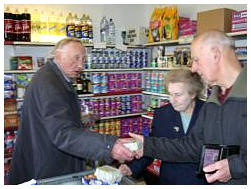
Colin (right) is pictured here with
Bernard Osborn in Osborn’s shop


- Photos
- Aston Abbotts - Winter Pictures
- Aston Abbotts How It Was
- Villagers Pictures - General
- Villagers Pictures - Ken Rhodie
- 630 Club Bean Competition 2011
- Astonbury X 2011 - Page 1
- Astonbury X 2011 - Page 2
- Astonbury X 2011 - Page 3
- Vic Scott Memorial Orchard
- Christmas Lunch 2011
- Peter Kent's Photographs
- Jubilee Picnic 2012
- Village Orchard - One Year On
- Village Orchard - Autum 2012 Planting
- Astonbury 2012
- Videos
- Interviews

